Crafting with wood isn’t solely the domain of adults equipped with extensive tool kits and grimy workshops. Children, too, can partake in this enjoyable activity — in a secure and inventive manner. Indeed, undertaking modest wood projects offers an excellent avenue for nurturing creativity, fostering self-assurance, and imparting practical abilities.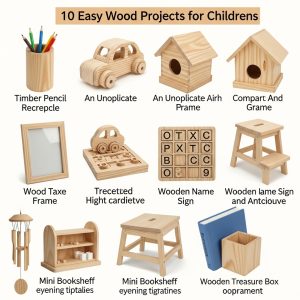
Therefore, if you’re seeking straightforward woodworking endeavors that are uncomplicated, secure, and engaging, your search ends here. Let’s begin our exploration.
Understanding the Value of Woodcraft for Children
Prior to delving into the specific projects, it’s worthwhile to discuss the significance of these activities.
Cultivates Self-Esteem and Inventiveness
When a child transforms an ordinary wooden block into a functional object, it can feel genuinely enchanting. It’s akin to witnessing a pristine canvas evolve into an artistic triumph. The declaration of “I crafted this myself!” is, without a doubt, invaluable.
Enhances Fine Motor Abilities
Actions such as measuring, smoothing with sandpaper, and striking with a hammer significantly refine hand-eye synchronization and intricate motor capabilities. This constitutes education cleverly presented as recreation.
Instills Perseverance and Concentration
Engaging in woodworking imparts a quality often scarce in our contemporary, accelerated society: patience. It’s impossible to hasten the sanding process. Skipping the measuring step is likewise out of the question. This methodical approach is, indeed, highly advantageous.
Prioritizing Safety: Implements and Oversight
Prior to grasping any tools, a discussion on safety protocols is essential.
Fundamental Child-Appropriate Equipment
Begin with basic items:
- A compact hammer
- A small hand saw (requiring adult guidance)
- Abrasive paper
- Adhesive for wood
- A tape measure
- Fastening clamps
Refrain from utilizing powered equipment for younger children unless under rigorous direct supervision.
Crucial Safety Guidelines
- Maintain constant oversight.
- Educate on correct tool manipulation.
- Ensure digits remain clear of potential cutting trajectories.
- Execute tasks upon a firm, steady platform.
List of Required Protective Equipment
- Protective eyewear
- Gloves for labor
- A mask for dust (especially during sanding activities)
Adhering to safety measures is not tedious; it is judicious.
Project: 1 – A Timber Pencil Receptacle
Straightforward, utilitarian, and ideally suited for novices.
Components Required
- A modest wooden block
- A drilling tool (with mature guidance)
- Abrasive sheets
- Coloring agents or drawing implements
Sequential Directives
Create uniformly spaced apertures within the wooden block. Smooth all edges using sandpaper. Allow your child to apply paint or adorn it. Mission accomplished!
This represents practical artistry.
Project :2 – An Uncomplicated Avian Shelter
A quintessential garden fixture.
Components Required
- Pre-fashioned timber sections
- Fasteners
- A percussive tool
- Adhesive for lumber
- Color pigments
Construction Manual
Construct the lateral panels, affix the overhead covering, and fasten the foundation. Permit children to adorn it with vibrant hues. Suspend it outdoors and observe avian residents take occupancy.
This undertaking is akin to fabricating a miniature dwelling for our winged companions.
Project :3 – A Compact Wooden Vehicle
Is there anyone who doesn’t appreciate miniature automobiles?
Components Required
- A modest wooden rectangular prism
- Four circular wooden pieces
- Cylindrical wooden rods
- Coloring agents
Method of Construction
Secure the wheels utilizing the cylindrical rods. Smooth the surface with abrasive paper. Apply decorative racing lines. It is now prepared for engagement.
Uncomplicated. Enjoyable. Expeditious.
Project :4 – Wooden Picture Frame
A creation imbued with sentiment.
Materials Needed
Four slender wooden strips
Timber adhesive
Securing clamps
Coloring agent or wood finish
Crafting Steps
Adhere the strips to form a rectangular enclosure. Allow it to fully cure. Embellish the frame. Place a cherished photograph inside.
Beyond mere timber, it transforms into a cherished keepsake.
Project :5 – Tic Tac Toe Board
Recreation combined with carpentry equals success.
Materials Needed
Smooth timber panel
Pigment
Diminutive timber tokens
Painting and Finishing
Sketch a lattice pattern. Apply ‘X’ and ‘O’ markings onto miniature wooden discs. Apply a transparent protective coating for longevity.
Evening entertainment for the household has been elevated.
Project :6 – Small Step Stool
Slightly more intricate, yet highly gratifying.
Materials Needed
Timber planks
Fasteners
Screw-driving tool
Abrasive paper
Building Guide
Fasten the support legs firmly to the upper surface. Abrade meticulously. Verify its steadiness.
It offers utility and instills confidence — children derive immense pleasure from utilizing their own creations.
Project :7 – Wooden Name Sign
Individualized and imaginative.
Materials Needed
Smooth timber slab
Coloring agent
Templates (voluntary inclusion)
Personalizing the Sign
Inscribe the child’s given name with paint. Incorporate celestial bodies, cardiograms, or preferred motifs. Affix it to the entrance of their sleeping quarters.
It imparts a sense of formal recognition, akin to their personal dominion.
Project :8 – Mini Bookshelf
Ideal for evening narratives.
Materials Needed
Compact timber panels
Securing pins or threaded fasteners
Striking tool or rotating fastener driver
Assembly Instructions
Connect the lateral panels to the foundation. Affix an upper storage surface. Abrasively refine until even.
Henceforth, their cherished literary works possess a dedicated abode.
Project :9 – Wooden Treasure Box
Each youngster requires a clandestine storage compartment.
Materials Needed
Compact timber container
Pivoting connectors
Colorant
Adornments
Decorating Ideas
Incorporate shimmering particles, adhesive labels, or painted designs. Mount diminutive pivotal connectors with assistance.
It transcends being a mere receptacle — it embodies a chest of riches.
Project :10 – Wind Chime
Melody converges with artisanal skill.
Materials Needed
Timber sections
Cordage
Boring tool (grown-up supervision required)
Coloring agent
Assembly and Hanging
Bore apertures, pass cordage through, and secure components to a foundation. Suspend it in the open air.
Permit atmospheric currents to complete the process.
Tips for Making Woodworking Fun for Kids
Maintain Undertakings Concise and Uncomplicated
Youngsters’ attention wanes rapidly. Select endeavors capable of completion within a single diurnal period.
Grant Children Autonomy in Design Selections
Desire a vibrant fuchsia hue? Proceed with that. Asymmetrical contours? That signifies distinctiveness.
Flawlessness is not the objective. Self-articulation holds precedence.
Closing Remarks
Engaging in modest woodworking ventures with children transcends simple craft activities; these projects are profound architects of self-belief. They instill crucial virtues like perseverance, imaginative problem-solving, and tangible capabilities, in a manner utterly inaccessible through digital interfaces.
An extensive, dedicated workspace is entirely unnecessary. All that’s truly essential is a modest collection of implements, a measure of attentive adult oversight, and an open readiness to empower children in their explorations.
So, what exactly is holding you back? Procure some timber, assemble the children, and begin forging cherished memories — one manageable creation at a time.